Why Knowing Your Colours Can Make Getting Ready So Much Easier
Getting ready should be simple. Yet somehow, choosing what to wear can turn into standing in front of a wardrobe full of clothes and thinking, “Why does nothing look right today?”
Then comes makeup. Should you choose a warm or cool lipstick? Does that blush actually suit you? Why does one shade make your complexion look fresh while another seems slightly off, even though both looked beautiful in the store?
Sometimes, the problem isn't that you need more clothes or makeup. You may simply need a better understanding of which colours work best for you.
That is where personal colour analysis comes in.
What Is Personal Colour Analysis?
Personal colour analysis is a systematic method of evaluating how different hues, tones, and contrast levels interact with your natural features—specifically your skin undertone, eye color, and hair tone.
Originating in the 20th century and recently experiencing a massive global resurgence (largely driven by viral trends in South Korea and modern image consulting), colour analysis categorizes individuals into distinct color palettes. Most systems utilize the classic four-season approach—Spring, Summer, Autumn, and Winter—which is often broken down further into 12 or 16 sub-seasons to capture subtle nuances.
The goal isn't to restrict what you can or cannot wear, but to identify the specific shades that harmonize naturally with your physical features.
The Science of Colour Harmony: Why Certain Shades Work (and Others Don't)
Have you ever put on a sweater and immediately looked well-rested, bright, and glowing—only to try on another shade of the same style and suddenly look tired or washed out?
This optical illusion comes down to how light reflects off fabric onto your skin:
- Undertone: Warm vs. Cool
- Warm undertones have golden, yellow, or peachy base notes. Earthy hues, golden greens, warm terracottas, and rich creams complement these tones by mirroring their internal warmth.
- Cool undertones feature pink, blue, or ruddy base notes. Crisp whites, berry tones, slate grays, and jewel-toned blues reflect cool light back onto the face, enhancing clarity.
When you wear a shade opposite your natural undertone near your face, it can cast unflattering shadows, highlight dark circles, or make your complexion appear slightly sallow or grayish.
- Value: Light vs. Deep
Value refers to how light or dark a color is. Someone with low-contrast, light features (blonde hair, light eyes, fair skin) may look overwhelmed by ultra-dark, heavy colors like jet black, whereas someone with high-contrast, deep features thrives in bold, deep hues.
- Chroma: Bright vs. Muted
Chroma measures a color's intensity and saturation.
- Bright/Clear types shine in vivid, saturated primary colors (like bright poppy red or electric blue).
- Muted/Soft types look best in dusted, blended shades (like sage green, dusty rose, or soft navy) that complement their softer features.
The Benefits of Finding Your Personal Palette
Understanding your optimal colour palette goes far beyond looking nice in photos. It transforms how you interact with your closet and your morning routine:
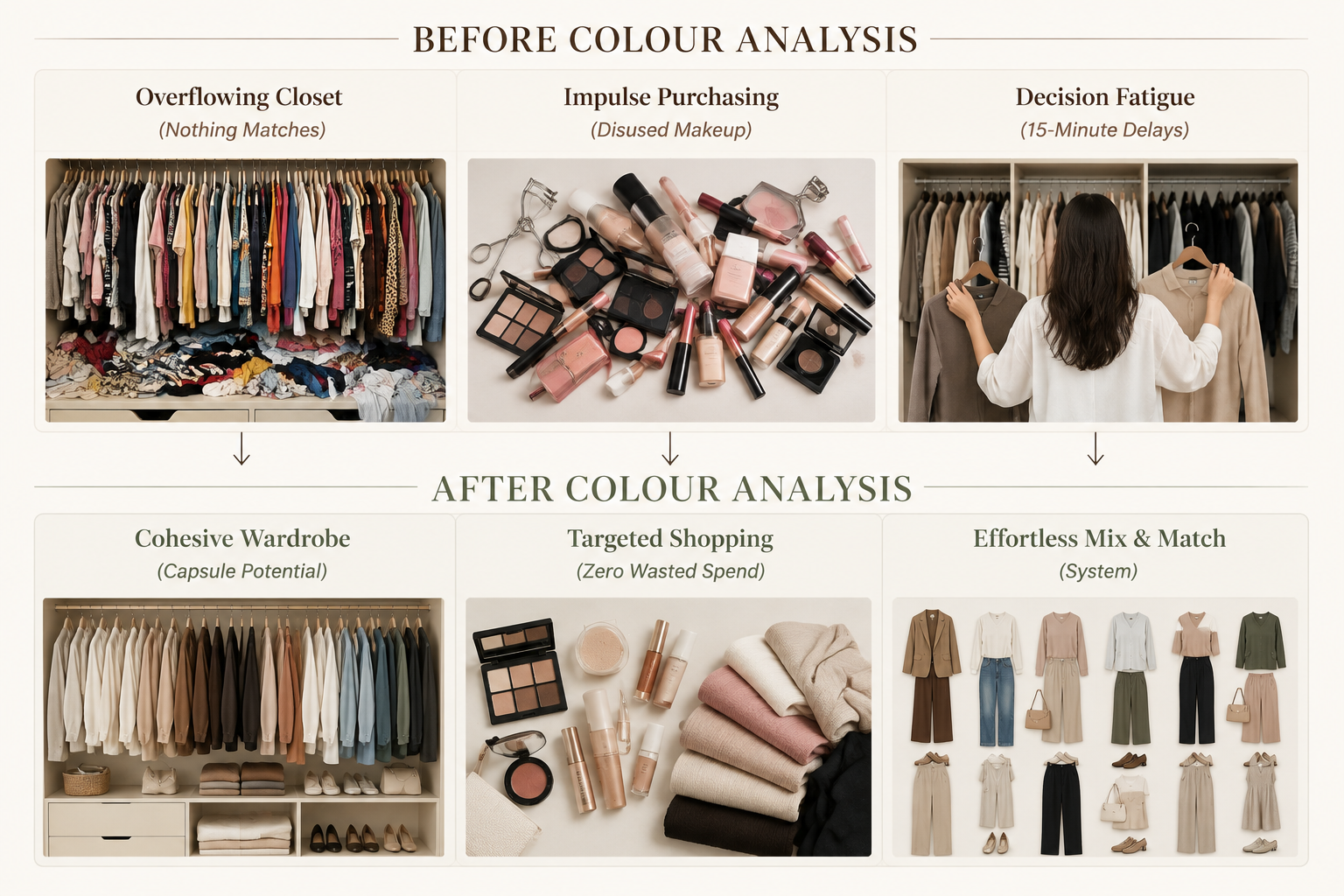
1. End Decision Fatigue and Save Time
When your wardrobe consists of colors that naturally complement both you and each other, dressing becomes practically automatic. Items pair together effortlessly because they share compatible undertones and saturation levels. You spend less time trying on five different outfits and more time heading out the door with confidence.
2. Streamline Your Makeup Bag
Buying makeup can feel like an expensive game of trial and error. Knowing your palette eliminates the mystery:
- Cool Palettes: Look effortlessly fresh in berry, mauve, cool plum, and blue-toned reds.
- Warm Palettes: Thrive in coral, peach, terracotta, warm nude, and brick-red shades.
Instead of keeping ten unused lipsticks sitting in a drawer, you can curate a tight collection of three or four shades that you know look fantastic on you every single time.
3. Build a Sustainable, Cost-Effective Wardrobe
Fast fashion and viral trends tempt us with colors that might look stunning on a display mannequin or screen model, but fail to work for us in real life. Knowing your personal palette acts as an intentional filter when shopping. You buy less, wear what you own far more frequently, and prevent unworn clothes from accumulating at the back of your closet.
A Simple Self-Check: Discovering Your Primary Tones
While booking a professional consultation with fabric drapes is the most precise way to determine your full season, you can start testing your undertones at home with these three simple checks:
- The Vein Test: Look at the veins on your inner wrist under natural sunlight.
- Predominantly green? You likely have warm undertones.
- Predominantly blue or purple? You likely have cool undertones.
- A mix of both? You may have a neutral undertone.
- The Jewelry Test: Hold up a piece of bright gold jewelry and a piece of shiny silver jewelry next to your face in natural light.
- If gold brings out a healthy, vibrant glow in your face, you lean warm.
- If silver makes your skin look clear, luminous, and smooth, you lean cool.
- The Pure White Test: Hold a stark, bright paper-white fabric up to your un-makeuped face, then swap it for a soft ivory/cream fabric.
- If stark white brightens your eyes and skin, you lean cool (or high contrast).
- If stark white makes you look washed out, but ivory instantly warms you up, you lean warm.
Making Rules Work for You, Not Against You
It's important to remember that personal colour analysis is a tool for empowerment, not a strict set of restrictive rules.
If your absolute favorite color falls outside of your recommended palette, you don't have to throw it away. You can easily adapt it:
- Keep it away from your face: Wear your non-palette colors in pants, skirts, shoes, or handbags.
- Layer strategically: Pair a non-ideal top with a scarf, jacket, or necklace in one of your best "power colors" close to your neck.
- Adjust your makeup: Wearing a bolder lip shade from your palette can easily balance out an outfit color that isn't naturally your best.
Discover Your Colours
Curious about which shades work best for you?