
Why Everyone Wants an “Experience” Now Instead of Just a Product
There was a time when consumerism was straightforward. You needed caffeine, so you bought a bag of ground coffee. You needed a vacation, so you booked a standard hotel room with two queen beds. You loved music, so you went to the store and bought a physical CD. Value was tied directly to utility and ownership.
Today? We pay $8 for a lavender oat-milk latte served in a sunlit, plant-filled industrial warehouse while a curated indie playlist plays in the background. We don't just stream albums, we spend thousands on concert tickets, limited-edition pop-up drops, and exclusive digital community access.
The economic shift is undeniable: consumers are actively swapping ownership for experience.
This isn't just a fleeting trend driven by viral social media posts. It represents a fundamental shift in human psychology, economic structure, and consumer culture. Here is a deep dive into why this transition is happening, the psychological forces powering it, and how businesses must adapt to survive.
1. The Clutter Paradox & The Rise of Digital Minimalism
For decades following World War II, status was defined by accumulation. The larger your house, the newer your sedan, the fuller your walk-in closet—the more successful you were perceived to be.
However, we have hit what sociologists call "Peak Stuff." Global supply chains and mass manufacturing made physical goods cheaper, faster to produce, and more accessible than at any point in human history. But this accessibility triggered an unintended consequence: material fatigue.
- The Burden of Ownership: Physical objects require maintenance, storage space, insurance, and eventual disposal. As living spaces in urban centers shrink and housing costs rise, physical clutter creates genuine psychological strain.
- The Erosion of Status: When high-quality physical goods become commoditized and easy to acquire (or replicate via fast fashion and knockoffs), ownership loses its ability to convey prestige.
- The Minimalist Counter-Culture: Led by movements toward decluttering and conscious consumerism, modern shoppers—particularly Millennials and Gen Z—are rejecting physical clutter.
Physical goods age, gather dust, depreciate, and eventually feel like anchors. Experiences, by contrast, occupy zero square feet, require no storage units, and appreciate in value as memories become fond nostalgia.
2. Identity Shift: From "What I Own" to "Who I Am"
Historically, identity was outward and object-oriented: “I drive a luxury sports car, therefore I am prosperous.”
Today, personal identity has become experiential and narrative-driven: “I spent two weeks trekking the Patagonia trails, therefore I am adventurous,” or “I regularly attend sound baths and breathwork retreats, therefore I prioritize wellness.”
Why Stories Beat Possessions
- Uniqueness: Two people can buy the exact same iPhone, jacket, or watch, making the product generic. However, no two people experience the exact same concert, travel itinerary, or dining event. Your experiences are uniquely yours.
- Conversation Equity: A physical object sitting in your living room is only seen by those who physically enter your house. A story about a unique experience, a skill learned at a workshop, or a transformative event can be shared across social circles and digital networks forever.
- Memory Bumping: Psychological research consistently shows that while the joy of buying a physical object decays rapidly (a concept known as hedonic adaptation), the happiness derived from experiences actually increases over time as we reframe and fondly recall those moments.
3. The Psychology of "Social Proof" in the Digital Age
It is impossible to analyze the Experience Economy without acknowledging the digital environments where modern life takes place. Platforms like Instagram, TikTok, and YouTube run on context, narrative, and movement—not static objects.
A photo of a designer handbag on a bed might receive casual double-taps, but a 15-second video of yourself sipping an espresso on a cliffside balcony overlooking Amalfi tells a rich story about your lifestyle, tastes, and values.
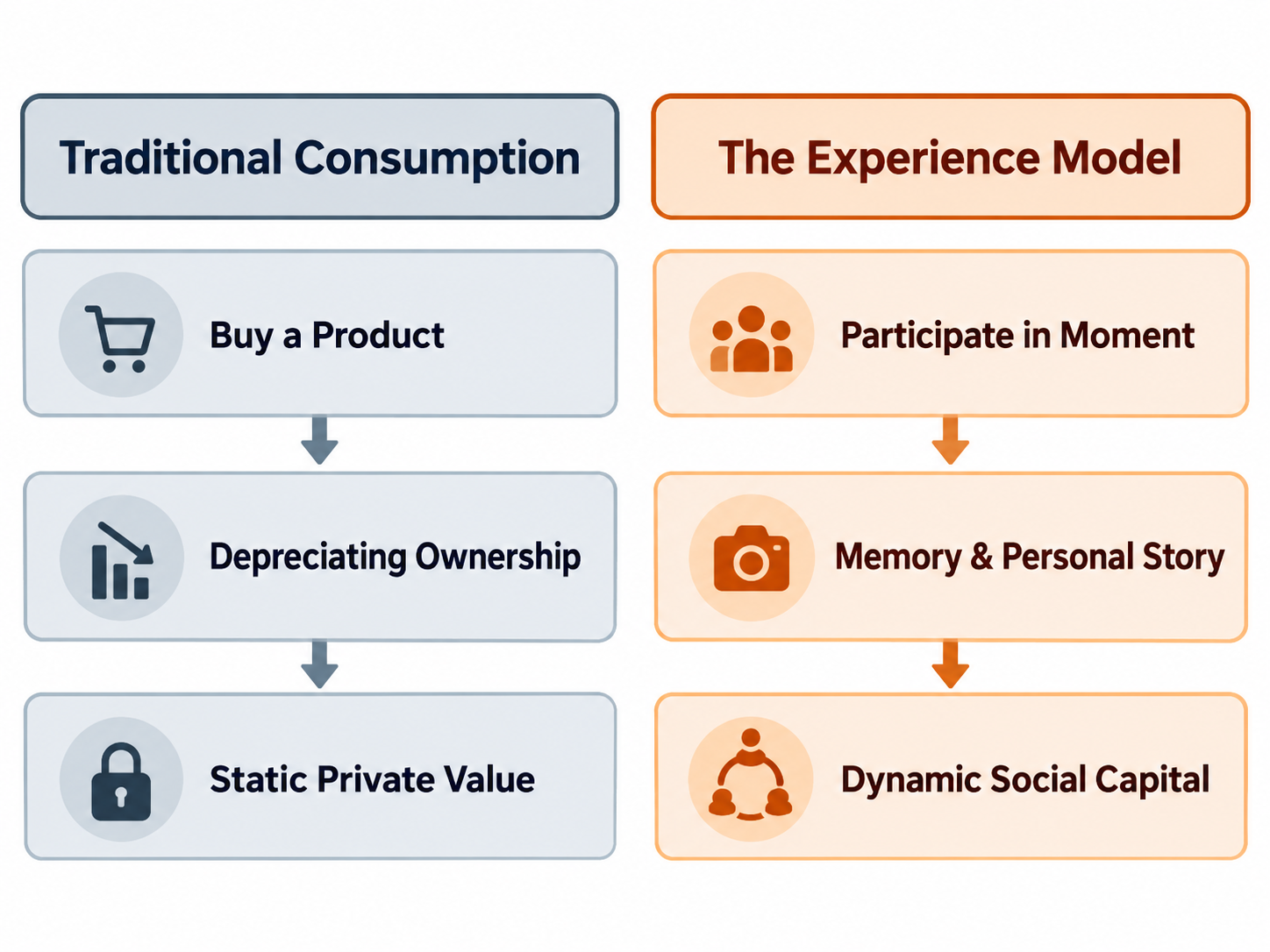
Social algorithms inherently reward visual dynamics, environmental aesthetics, and active participation. This reality has forced brick-and-mortar retail, hospitality, and entertainment industries to redesign their physical spaces specifically to be photographed, recorded, and shared. The physical environment itself has become the primary marketing channel.
4. The Antidote to Screen Fatigue & Digital Isolation
We live in an era of hyper-convenience and hyper-isolation. We work remotely on laptops, order meals with a few taps, communicate via messaging apps, and entertain ourselves with algorithmically tailored streaming content.
While this digital ecosystem offers efficiency, it starves us of sensory richness and genuine connection.
- Tactile Engagement: Digital interaction engages only two senses: sight and sound. Experiential consumption engages all five—tactile textures, distinct aromas, environmental temperature, ambient noise, and physical movement.
- Shared Energy: Streaming a live concert on a 4K TV is technically clearer, but it lacks the collective effervescence of standing in a crowd of thousands of people singing the same lyric in unison.
- The Need for a "Third Place": Sociologist Ray Oldenburg coined the term "Third Place" to describe social environments separate from the two usual environments of home ("first place") and the workplace ("second place"). As traditional third places (churches, community halls, civic clubs) decline, experiential retail and hospitality spaces are stepping in to fill the social vacuum.
5. Deconstructing the Experience Economy Framework
Economists B. Joseph Pine II and James H. Gilmore formally defined this evolution in their seminal work, The Experience Economy. They demonstrated how economic value progresses through distinct evolutionary stages:
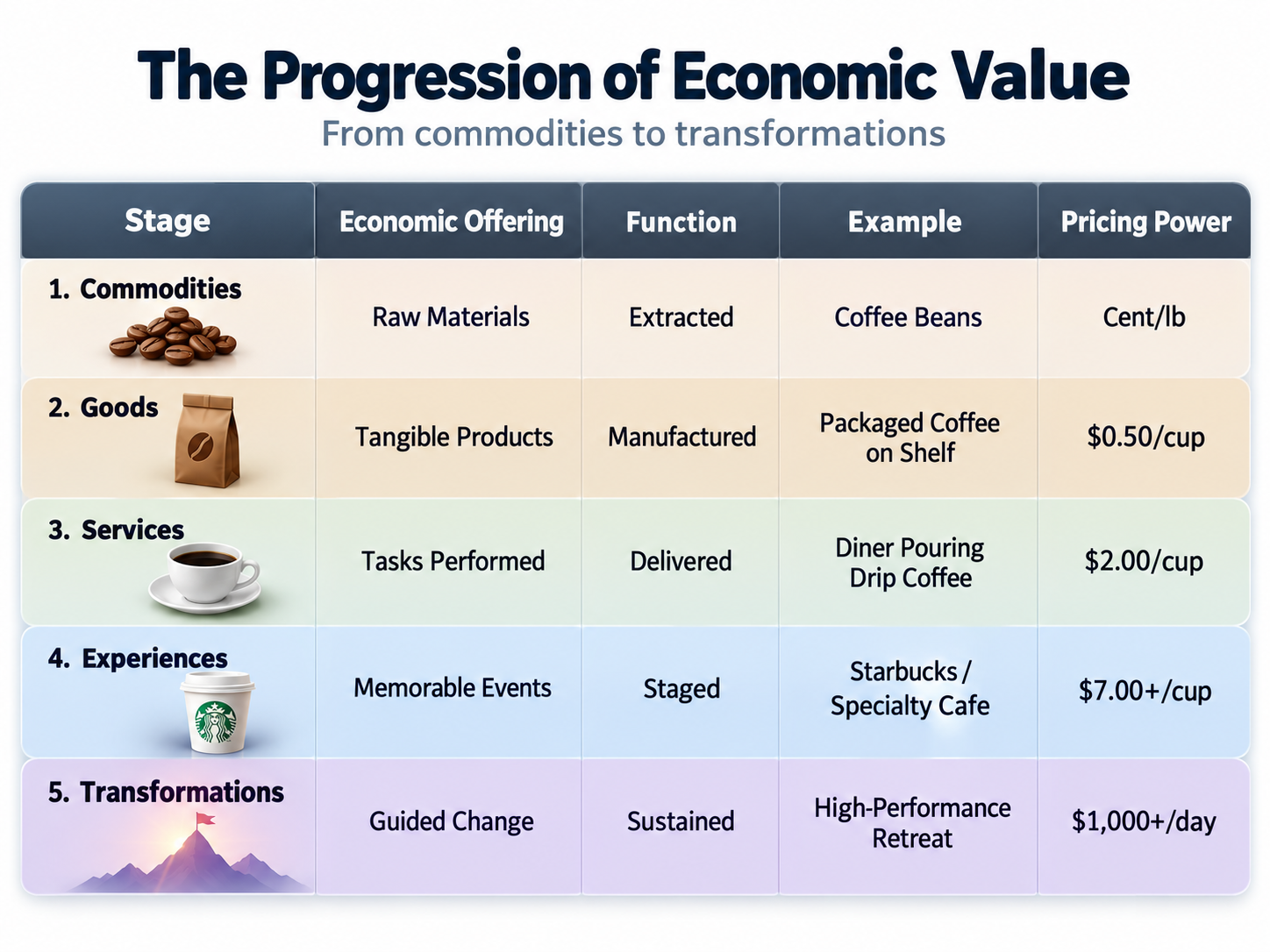
We are currently transitioning from Stage 4 (Experiences) into Stage 5 (Transformations). Modern consumers aren't just paying for a fun Saturday afternoon; they are increasingly willing to pay premium prices for experiences that change their health, perspective, skills, or mindset.
6. How Traditional Brands Are Pivoting (Case Studies)
If you sell a tangible physical product, this cultural shift isn't a death sentence—it is an invitation to innovate. Leading brands across sectors are redefining themselves by embedding experiences directly into their product offerings.
Nike: From Shoe Vendor to Athletic Hub
Nike stopped relying solely on shoe racks in department stores. Instead, they built high-concept flagship stores featuring trial basketball courts, custom product-creation labs, running analysis stations, and local run-club meetups.
Apple: Reimagining the Town Square
Apple Stores notoriously devote massive square footage to non-transactional spaces. Through their "Today at Apple" programming, they offer free hands-on workshops on photography, video editing, coding, and music production.
RH (Restoration Hardware): Furnishing Meets Fine Dining
Rather than operating dry furniture showrooms in strip malls, RH transformed its locations into multi-story luxury experiences complete with rooftop restaurants, wine bars, landscaped gardens, and interior design consultancies.
Actionable Takeaways: How to Infuse "Experience" into Any Business
Whether you run an e-commerce brand, a local service, a tech startup, or a B2B firm, you can apply these principles:
- Map the Customer Journey Beyond the Transaction: What happens before and after the purchase? How can you make unboxing, onboarding, or customer support feel intentional, surprising, and memorable?
- Build Belonging, Not Just a Customer Base: Create spaces—digital or physical—where your customers can connect with each other around shared values, interests, or goals.
- Focus on Sensory Detail: Upgrade the touchpoints of your service. Consider physical design, ambient sound, custom packaging scents, visual presentation, and human interactions.
- Offer Transformation: Don't just sell the tool; help your customer achieve a personal or professional level-up. Frame your product as an enabler of a better version of themselves.
From Selling Products to Designing Meaningful Brand Experiences
In the Experience Economy, branding is no longer just about what a business sells—it is about how people experience, remember, and talk about the brand.
From personalised interactions to sensory details, storytelling, and community, every touchpoint can shape how customers feel about a business.