
The CEO of OpenAI Doesn’t Have the Loudest Personal Brand—So Why Does It Work?
In an era where many technology leaders build highly visible, outspoken online personas, OpenAI CEO Sam Altman has taken a noticeably different approach. While some executives rely on frequent social media commentary and dramatic public rivalries to maintain mindshare, Altman’s public presence is comparatively low-key, measured, and understated.
Yet, despite keeping a lower profile than many of his peers, he remains one of the most influential figures in modern business.
This raises a crucial question about executive visibility: Does building a strong personal brand actually require constant self-promotion?
For founders, executives, and professionals, the traditional playbook often preaches maximum visibility, posting daily, chasing viral moments, and leaning into hot takes.
However, examining alternative leadership styles shows that quiet authority can be just as potent. By using Sam Altman’s public presence as a case study, we can explore how a high-impact personal brand can be built on substance, credibility, and strategic communication rather than sheer volume.
1. Why Does a Strong Personal Brand Don't Need Constant Attention?
A common misconception in personal branding is that silence equals invisibility. Many professionals believe that if they aren't constantly publishing content or weighing in on trending news cycles, their audience will forget them.
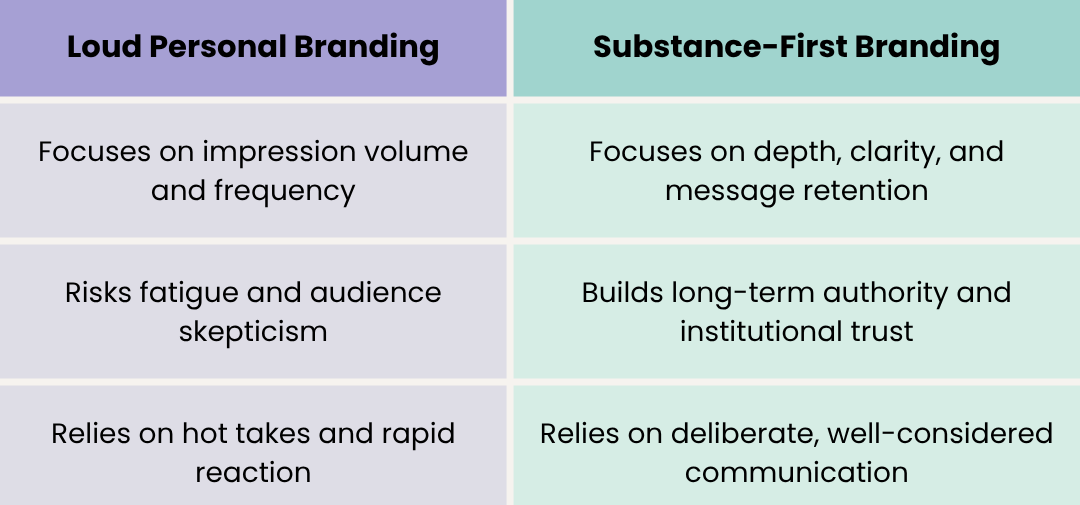
However, high frequency can sometimes dilute authority.
When a leader speaks only occasionally, their audience pays closer attention when they do. A measured public cadence signals emotional control and strategic focus—qualities that are particularly vital in high-stakes industries, emerging tech, or complex enterprise environments.
Consider how this plays out in practice. In high-volatility sectors like artificial intelligence, constant public hype can fuel skepticism and regulatory concern. By maintaining a quiet, serious, and deliberative tone, Altman provides an anchor of stability for OpenAI. His restrained style invites institutional trust from enterprises, partners, and policymakers who might otherwise be wary of aggressive marketing tactics.
What Professionals Can Learn
Key Takeaway: You don't need to post daily to build authority. Focus on the depth of your insight rather than the frequency of your output. When you speak less often, your words carry far more weight.
2. Great Personal Brands Focus on Results, Not Noise
In personal branding, leverage comes from a simple dynamic: when your professional output is strong enough, your personal brand doesn't need to rely on self-promotion.
A personal brand should be an amplifier for your work, not a substitute for it. Leaders who focus heavily on personal image without backing it up with clear results often struggle with long-term credibility. Conversely, executives who let their products, research, or team outcomes take center stage naturally earn a reputation for competence.
As a case study, Altman’s media appearances rarely focus on his individual story or personal lifestyle. Instead, he positions himself as a spokesperson for OpenAI’s collective research and user adoption metrics. By redirecting the spotlight toward the technology, the organization's execution becomes the primary engine driving his reputation.
What Professionals Can Learn
Key Takeaway: Whether you are a marketer, entrepreneur, or manager, your expertise should always be louder than your self-promotion. Instead of asking, "How do I become more visible?" try asking, "How do I make my work more valuable?"
3. Authenticity Builds a Strong Personal Brand
Modern audiences are adept at spotting corporate spin and over-polished PR.
One of the fastest ways to build trust through personal branding is to embrace strategic candor—the willingness to openly acknowledge limitations, trade-offs, and uncertainties.
When a professional pretends to have every answer, it raises suspicion. Admitting what isn't working yet creates a perception of objectivity and honesty.
Altman frequently uses this approach in public interviews. Rather than presenting AI models as flawless, he routinely highlights their current limitations, discusses market uncertainties, and admits where the technology still needs improvement. This transparency renders his positive announcements far more believable, as audiences perceive him as a pragmatic communicator rather than a cheerleader.
What Professionals Can Learn
Key Takeaway: People trust professionals who admit uncertainty. If you don't know the answer to something, say so. If a project didn't go as planned, explain what you learned from the experience. Honesty builds credibility much faster than projecting perfection.
4. Personal Brands Should Elevate the Ecosystem Around Them
A personal brand built entirely around an individual's ego can be fragile. When a leader's public persona is hyper-focused on self-aggrandizement, it leaves little room to showcase the strength of the broader organization.
The most enduring personal brands are ecosystem-centric. They use their platform to elevate colleagues, highlight industry partners, and address broader community challenges.
Drawing from his background supporting founders at Y Combinator, Altman operates publicly as an ecosystem builder. His personal brand is closely tied to bringing together capital, infrastructure, and talent across the tech sector. By highlighting researchers, discussing broader societal impacts, and working with external institutions, he projects the image of a collaborative leader rather than an isolated hero.
What Professionals Can Learn
Key Takeaway: Use your personal platform to highlight the work of your team, partners, and peers. When you help build the ecosystem around you, your reputation grows alongside it.
Build a Brand People Trust, Not Just Notice
In a digital world where visibility is often mistaken for influence, it's easy to believe that building a personal brand means constantly creating content, sharing opinions, or staying in the spotlight. But as this case study illustrates, influence isn't always measured by how often you're seen—it's measured by how you're remembered.
Whether you're a founder, manager, marketer, or someone just starting your career, your personal brand is shaped by the value you create, the trust you earn, and the consistency you demonstrate over time.
The strongest personal brands aren't built overnight, nor are they built on algorithms alone. They're built through credibility, authenticity, and a willingness to let your work speak for itself.
So instead of asking, "How can I get more attention?", consider asking:
- What do I want to be known for?
- How can I create more value for the people I work with?
- What reputation am I building every day through my actions?
Because in the long run, the most effective personal brand isn't always the loudest—it's the one people trust.
Ready to Build a Personal Brand That Stands Out?
If you're looking to strengthen both your personal brand and your professional skill set, explore our AI & Digital Skills Course. You'll learn practical ways to use AI for content creation, productivity, marketing, and day-to-day business tasks—skills that are increasingly valued across industries.
Discover how AI can help you work smarter and build a stronger professional presence.