
AI Skills Are Becoming Mainstream: Is Being ‘AI Ready’ the New Career Basic?
There was a time when listing "Microsoft Office" or "Web Browsing" on a resume made you stand out. Eventually, those line items vanished—not because they weren't useful, but because knowing how to use a computer became the baseline expectation for almost any office role.
We have reached that exact turning point with artificial intelligence.
Over the past few years, AI transitioned from an experimental novelty into an everyday workplace utility. Today, over 85% of knowledge workers regularly use AI tools in their daily workflows. The shift is no longer about whether professionals are using AI; it is about how effectively they use it.
Being "AI ready" is no longer a specialty reserved for software engineers or data scientists—it has officially become the new baseline career expectation across every industry.
The Shift: From Technical Specialization to Everyday Baseline
When generative AI tools first burst onto the scene, the initial corporate response focused on specialized hires: machine learning engineers, AI researchers, and prompt engineers.
However, workforce data reveals that over 50% of AI-related job requirements are now in non-IT roles, including marketing, human resources, finance, operations, and business strategy.
Employers aren't asking average knowledge workers to build proprietary neural networks or write Python code from scratch. Instead, they expect employees to use AI tools to solve routine business problems, eliminate administrative friction, and accelerate execution.
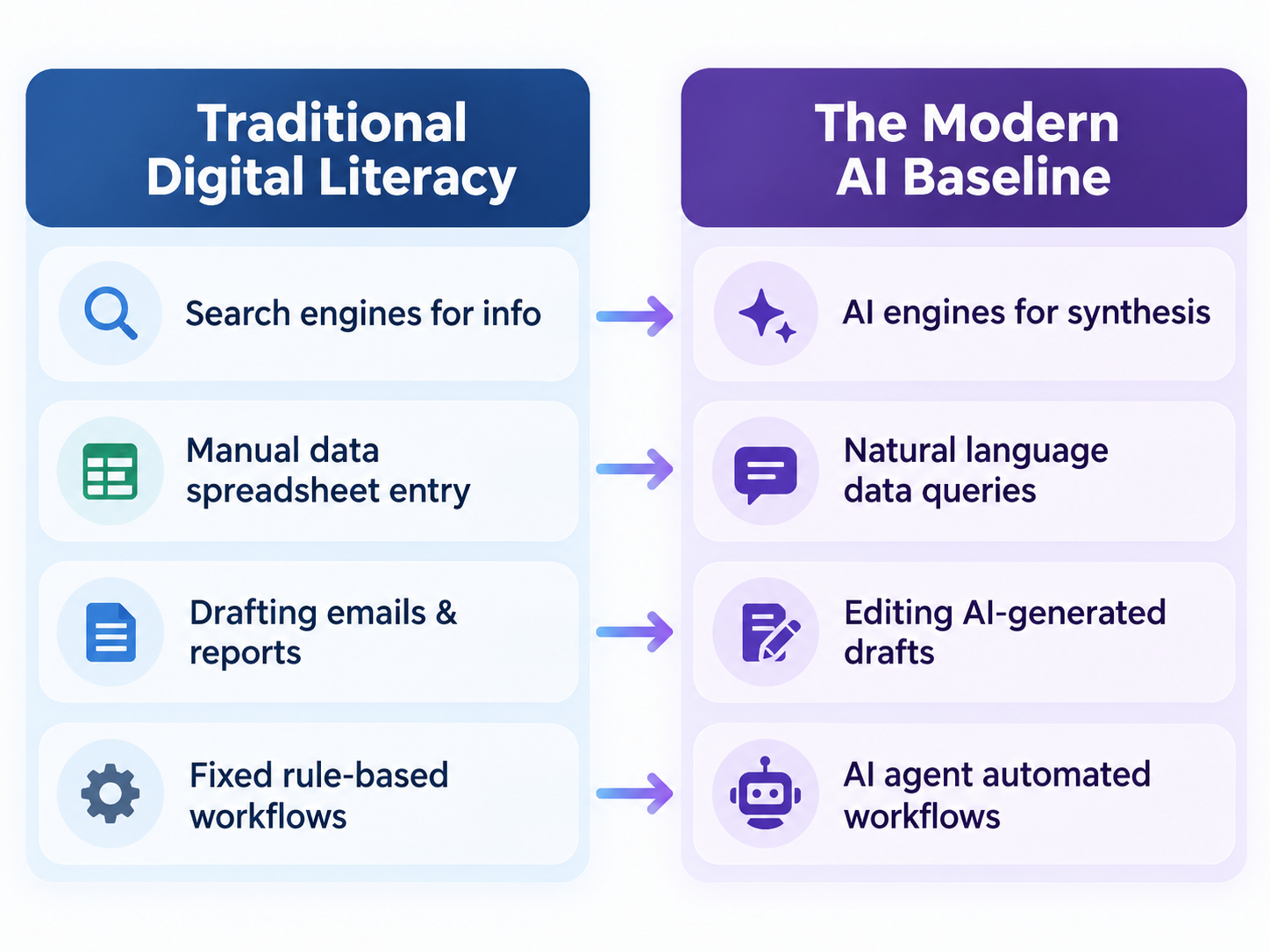
What Does Being "AI Ready" Actually Mean?
Being "AI ready" doesn't mean memorizing every new tool that launches each week. It means developing a practical set of core competencies that change how you approach daily work:
1. AI Literacy & Critical Verification
AI literacy is the foundation. It means understanding what AI models excel at (synthesis, pattern recognition, drafting) and where they fail (hallucinations, context blindness, bias). An AI-ready professional knows how to audit output, verify facts, and apply critical judgment before hitting "send".
2. Context Engineering & Problem Structuring
While basic "prompting" got people started, modern AI readiness relies on context engineering—the ability to give an AI system the right background, constraint boundaries, data, and persona so it produces high-value, actionable results on the first attempt.
3. Workflow Automation
Rather than treating AI as a conversational search engine, AI-fluent workers build lightweight automated workflows. They connect tools to summarize meeting transcripts, triage incoming customer inquiries, analyze monthly spreadsheets, and draft routine communications automatically.
4. Ethical & Security Boundaries
Understanding data privacy, intellectual property, and internal governance is critical. Being AI ready means knowing what sensitive company data should never be pasted into a public LLM and ensuring AI-assisted decisions remain ethical and unbiased.
The "AI Advantage" vs. The "AI Gap"
The job market is splitting into two distinct categories:
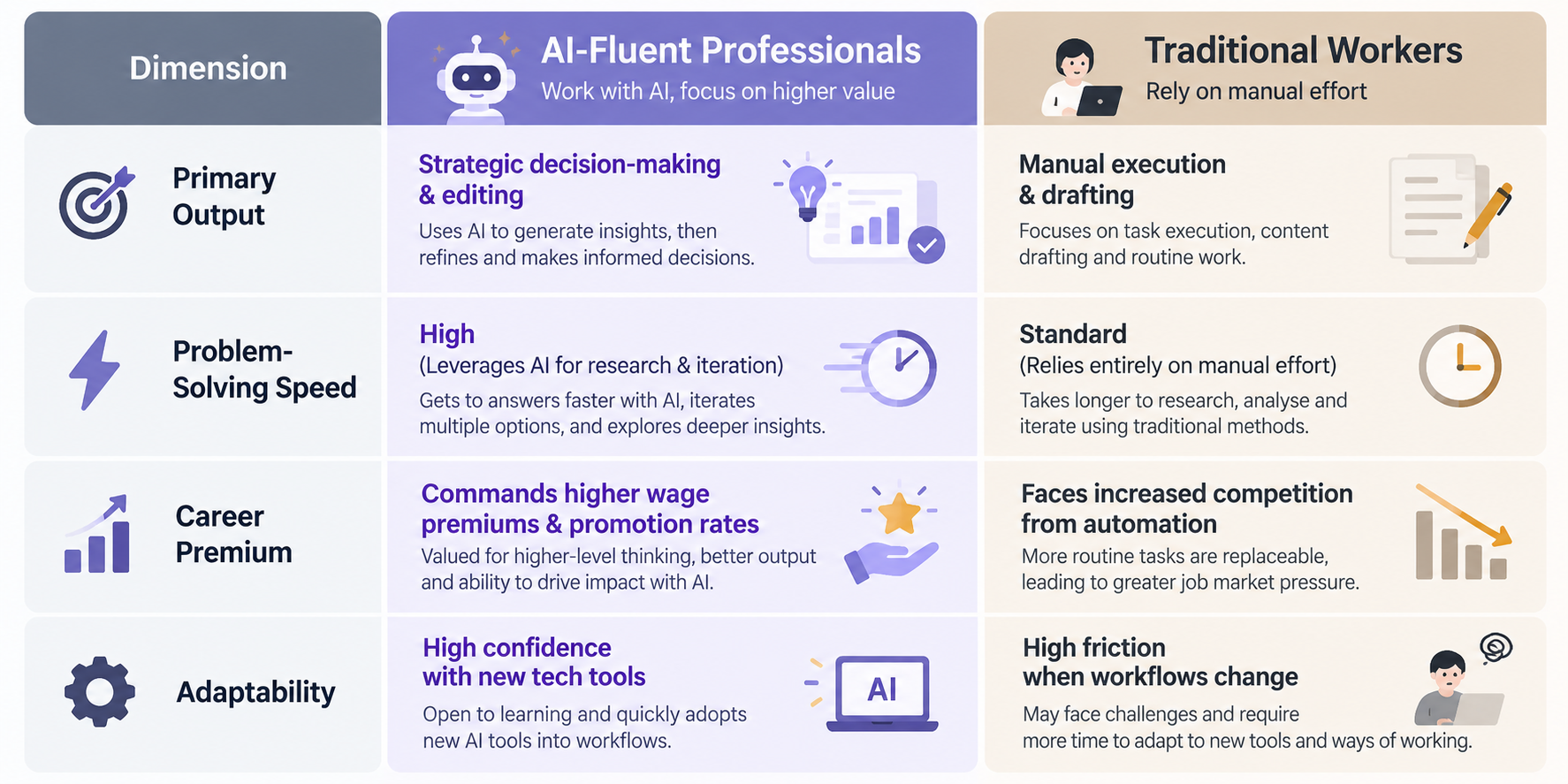
Studies show that professionals with proven AI competencies earn a noticeable wage premium compared to peers in identical roles without AI skills. Employers are willing to pay more for workers who can produce double the output without doubling their working hours.
How to Future-Proof Your Career Today
If AI readiness is the new career basic, how do you catch up or stay ahead?
- Shift from Consumer to Co-Pilot: Stop asking AI for trivia. Treat it as a junior analyst sitting next to you. Delegate your most tedious, repetitive task to an AI tool this week.
- Focus on Soft Skills: As routine tasks like summarizing, drafting, and data organizing become automated, uniquely human skills—such as strategic thinking, empathy, negotiation, and complex leadership—become significantly more valuable.
- Build an "AI Sandbox" Habit: Dedicate 30 minutes a week to experimenting with new features or tools in your field. Familiarity reduces anxiety.
AI Readiness Is Becoming a Career Essential
AI is quickly becoming less of a specialist skill and more of an everyday workplace capability. The advantage will not come from simply knowing that AI tools exist, but from knowing how to use them responsibly, strategically, and effectively in real work.